The story of Takaharju and Punkaharju
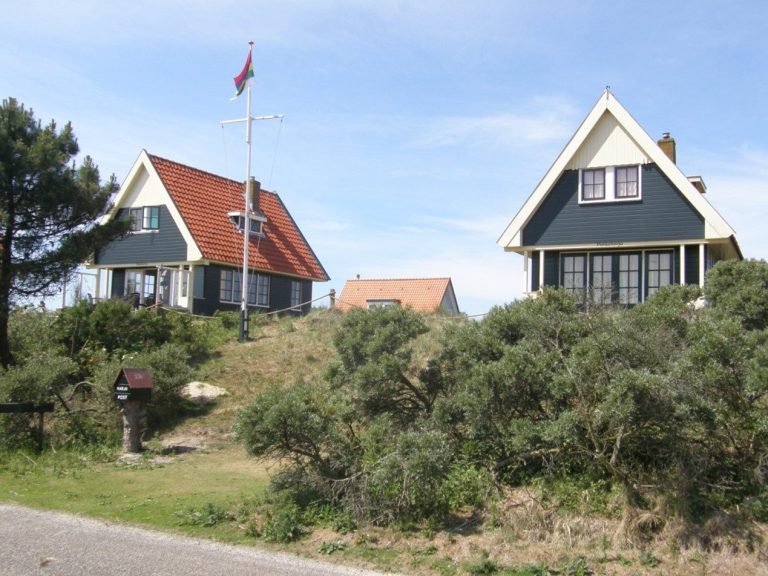
The two summer houses with the most beautiful stories behind their names are located in the dunes near Midsland aan Zee.
For those unfamiliar with the history of the houses, Takaharju and Punkaharju are very strange words. Their origin lies in Finland. Mr. Zonneveld, son of the owners of Punkaharju and son-in-law of the owners of Takaharju, is happy to tell the story.
"At the beginning of this century[1] a sailor named Kees (Cornelis) Swart lived in Midsland. He sailed, like so many Terschelling sailors, in the Baltic countries[2]. One time, probably around 1928, he was sailing in the Gulf of Bothnia and suddenly developed tuberculosis.
He could not stay on board and was taken ashore in the Finnish town of Kristinestad, on Finland's west coast. From there, he went to the lake district in eastern Finland, to a sanatorium on the Takaharju peninsula, in the municipality of Punkaharju. The Finnish word 'harju' means 'a hill made of sand.' This meaning is understandable, as there is more water than land in this region. He was cared for there for about a year.
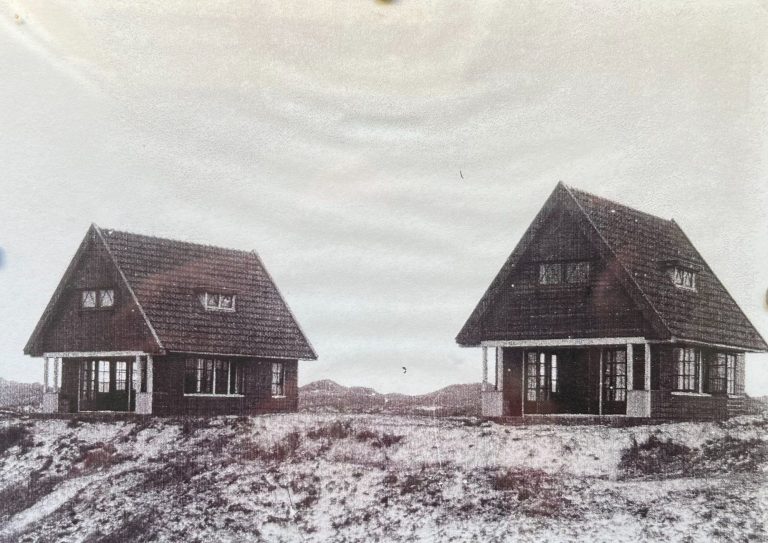
After returning home, he said goodbye to his sailor's life. He bought the 'Wapen van Terschelling' (Coat of Arms of Terschelling) at Oosterburen in Midsland and became a hotelier. He lived opposite the hotel at the time. In 1932, he bought materials from a contractor in Harlingen for two wooden summer houses. They were then built in the dunes of Midsland aan Zee. Carpenter Reijn Haan from Hoorn[3] was involved in the construction."
In 1973, the De Jong-Swart family sold the houses to the Zonneveld and Woelinga families. The two couples, interested in the history behind the names Takaharju and Punkaharju, traveled to Finland in 1981. "We visited the sanatorium (which still exists and is still called Takaharju) and spoke with the director. He knew the history quite well and even looked it up for us."
Some people believe the houses were built of Finnish wood and according to an authentic Finnish design. This is not the case. "They are simply kits. This type of house is also not unique, as there are two of them on Vlieland."
The only Finnish element on the houses is the Finnish flag, which still hangs from the mast.
Source: Schylger Stem – News and Background from Terschelling, number and year unknown.
[1] Must now be 20th century.
[2] There used to be a lot of trade between Terschelling and Riga.
[3] Rein Haan wrote his name on the roof ridge of the house (visible in the shed): "R. Haan June 1932".